Showing posts with label south korea. Show all posts

Thursday, 4 November 2010

Take a trip to the DMZ

Everybody comes to Korea with a list of things they want to do, see and accomplish as long as their arm. Taking in Asia seems to crop up on most of them, along with learning the language, taking up Taekwondo and, of course, saving money. But anybody with of a passing interest in history (or a slight penchant for voyeurism) is guaranteed to make a trip to the Demilitarized Zone that separates North and South. That it featured so highly on my own list is slightly worrying, but I’m happy to have checked it off and in the process of doing so, I had one of the most sobering, surreal experiences of my life.
DMZ

There are various trips to choose from, each with their own selling points and packages. I was sold on Adventure Korea’s promise to take me off the beaten track. Rolling through the deserted countryside beyond the civilian control point that precedes the DMZ, I felt reassured that they had kept their side of the bargain, but a slight unease at the eeriness of the surroundings.

The once bustling metropolis of Cheorwan has long since been reduced to a ghost town. Stray machinery peppers the endless rows of rice paddies, conceivably abandoned at the outbreak of war, but more probably by the farmers who must leave the zone before their curfew. It amounts to a whole lot of suspense before we reach the first point of the tour, the Second Tunnel.

One hundred and forty five metres deep and 3.5 kilometres long, the tunnel was intercepted 1.1 kilometres in to South Korean territory in 1975 and had the power to transport 16,000 soldiers an hour under the border. The figure beggars belief. I have to crouch as I make my way down to its base, wondering how long it would’ve taken to carve this into the rock. The guide reveals, to gasps of astonishment, that there is an estimated twenty other tunnels like this yet to be unearthed, but that despite the recent decline in relations, they don’t anticipate an invasion. His words emphasize just how volatile the Korean situation is.

The centerpiece of the tour is a visit to the Cheorwan Observation Centre, situated a mere stone’s throw from the DMZ, with a bird’s eye view of North Korea. Of course, there is scant opportunity to see what life is actually like in the most secluded country on earth, but the little we can see is equal parts fascinating and shocking. On the South Korean side, the farmland is lush, the vegetation rich; a reflection of an age of prosperity. It’s in marked contrast with what we see on the other side.

On the entry point to North Korea, the thriving nature reserve that has been created by default in the DMZ comes to an abrupt halt. Everything living has been flattened, lest it provide camouflage for anyone attempting to escape across the border. There is a North Korean army base visible, looming disturbingly large on a hilltop. The smoke of a fire evidently lit by there soldiers rose towards the sky. Since I’ve been in Korea (actually, since long before it), I have wondered about the North and the peninsula’s situation. Being within such proximity was surreal and if truth be told, thrilling.

Traveling to the DMZ was a worthwhile experience: interesting and enlightening… and, yes, fun. However, it would be advisable to keep your expectations in check. You will not see anything you’re not supposed to, so be realistic… if you manage to do so, you’ll be in for a real treat.

DMZ tours


Written for Say Kimchi News

Thursday, 30 September 2010

Feed The Boats @ Speakeasy Bar


Written for The Gwangju News

Hearing of a live rock band playing in Gwangju is a bit like seeing an oasis on the horizon after months of traipsing thirstily over scorched desert plains. Sure, the internet allows anybody with a modicum of know-how to keep up to date with whatever tickled their eardrums at home, but any active music fan begins to crave the sweat and grime of a ramshackle gig before long.

And so it was, on the weekend of Gwangju World Music Festival, that Speakeasy paid host to one of the most omnipotent bands in town, Feed The Boats. And the gods were seemingly on their side. With the weather ensuring the Festival was a washout, the boats were duly fed. Patrons streamed through the door in the shape of a one-fingered salute, directed at Festival organizers, who had chosen to overlook Speakeasy when selecting after-party venues for the event. Did somebody say karma?

In some respects, Feed The Boats couldn’t really fail tonight. A bunch of pie-eyed, gig-starved westerners are hardly the most difficult crowd to please, but credit where it’s due: they put on a good show. Their set list was well chosen: a mixture of crowd pleasers and what seemed to be personal favourites. The crowd, well oiled after a warm up set from Deserts, responded well to each number; dancing, singing along and hurling compliments toward the stage. The lead singer has an excellent voice: guttural and grungy, a refreshing take on Courtney Love or Brody Dalle. And so, it was no surprise when they launched into a rollicking Distillers number.

Likewise, their take on Mod classic A Town Called Malice is pleasing, but not wholly unanticipated, given the poker-faced Englishman in tow. Feed The Boats’ style is a well-worn brand of bar-rock; toying with alternative and EMO, before settling somewhere in the middle. The original numbers they play are greeted warmly, but it’s their versions of a couple of classics that will endure. The schism between The Crystals and The Replacements could never be overstated, so congratulations to Feed The Boats for going some way to bridge the gap, with an enjoyable rendition of And Then I Kissed Her and the Minneapolis outfit’s Bastards of Young, delivered in the only way it should be: loud, fast and rickety.

No, Feed The Boats won’t win any awards for originality, but they should be commended for providing what was certainly the most entertaining option on a Saturday night in Gwangju.


Video: The Replacements - Bastards of Young

Monday, 30 August 2010

Woobang Tower Jump, Daegu


Written for the Say Kimchi News

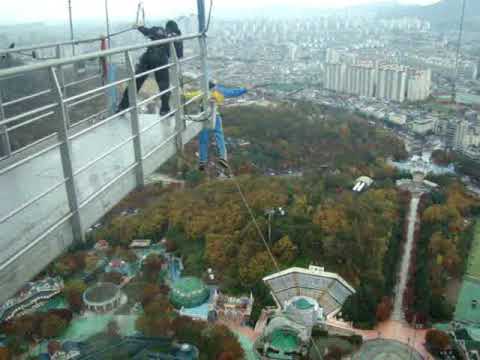
I’ve always been a bit of a coward, yet paradoxically, always been pretty keen on scaring the crap out of myself. I think I forget the first part until right before I’m about to do the second. Last week I had a couple of days off work, so I decided I’d go to Daegu to jump off a building. Daegu is Korea’s third city (if, like many, you consider Incheon to be part of Seoul) and home to Woobang Tower, the tallest tower in Asia. They’ve built an amusement park around it, WoobangTower Land, which seems similar in scale to Gwangju’s own Family Land: pretty small, but not bad for an afternoon if you’re at a loose end.

Woobang Tower is 202m high (312m in altitude) and is similar in structure to the CN Tower in Toronto, formerly the world’s tallest free-standing structure (553m) and one of the Seven Modern Wonders of the World. At the top of Woobang Tower is a revolving restaurant. There’s a 360° observation deck which gives you stunning, panoramic views of the city below which, incidentally, is huge. Coming from a small Irish town, Gwangju seemed sprawling to me (especially from the top of Mudeung Mountain), but Daegu is a massive step up in terms of scale. From the top of Woobang Tower, you really get an idea of how big it is.

We set off from Gwangju early in the morning and arrived around lunchtime. There were three of us, two jumpers and a photographer, and we met another friend in Daegu who jumped with us. We were all excited; laughing and joking without giving a moment’s consideration to what we were about to do. That was until the Tower became visible in the distance on the taxi ride to Woobang Land. It dominates the horizon. The closer we got, the taller it seemed and when we were within a few hundred metres of it, we saw a little gangway protruding from near the top. This was where we would fall from.

Feeling a little sheepish (and not a little sick) we made our way around the perimeter of the park until we reached the foot of the Tower. We paid (for three people, it was 100,000W, very reasonable) and got on the elevator for the 76th floor. The laughing stopped. Suddenly, it wasn’t funny anymore. Looking at each other for some sort of comfort was futile; the others were either praying or holding their hands over their faces. Yikes. There was a teenage girl ahead of us in the queue so we could see exactly what we had let ourselves in for and as she shimmied closer to the edge of the “plank”, white as a ghost, I felt nothing but sympathy!

The jump itself is not a bungee, which I initially thought, but a sky-jump. It’s like base jumping, except you have a cable attached to your back. Kitted out in the finest race suits this size of Talladega Nights, we decided on which order we would jump in (I was second) and then waited. As with most adrenaline-based activities, this is by far the worst part. Every sort of eventuality runs through your head until eventually, you’ve thought of all of the worst things that can happen and an accepting calm descends over you; at least for a minute. When my turn came I was led out to walk the plank. They strapped a harness onto me and explained a few things to me about what was going to happen. The problem is, I don’t speak Korean. I just smiled and nodded, such has become my custom in this fine nation.

I stood at the edge of the gangway for about a minute, getting properly strapped in. Then, I leaned forward, looking at the ground beneath me... it seemed like miles away! The attendant told me to let go and just like that, I was in suspended animation, 132 metres above a sprawling Korean metropolis. Hanging there, horizontally, was one of the most surreal experiences I’ve had. I was trying to squeeze out a smile, as the Korean guy is taking pictures of me (as part of the package, you get some photos and a certificate). And after what seemed like minutes (maximum hang time: 30 seconds), I was falling. This part is not frightening. You drop at a leisurely speed to a target at the bottom, where you’re released from your harness and left to ponder your “achievement”. Breathless and a little befuddled, I was greeted at the bottom by my friends. What a rush! For only 33,000W, the Woobang Tower Sky Jump is highly recommended.


Korean Grand Prix Preview


Written for the Gwangju News

On Sunday October 24th of this year, a cacophonous drone emanating from a stretch of tarmac in Yeongam, just south of Gwangju, will chauffer in a new era in Korean spectator sport. The country will join an elite band of 18 others in paying host to a Formula One Grand Prix. It is testament to Korea’s growing presence on the international stage that they have convinced F1’s governing body of their capability to host such a high profile event. Some speculate that it may bring even greater rewards to the nation than the 2002 World Cup. Should that be the case, Korean sport is in for a serious boost.

The inaugural South Korean Grand Prix will attract a crowd of around 130,000 to the newly built Korea International Circuit and officials have been scrambling to find ways to accommodate the masses due to descend on South Jeolla. Car parks are under construction, hundreds of shuttle buses are to be laid on. This sleepy, rural community is about to get a whole lot louder, but a few days of autumnal madness will undoubtedly bode well for the region’s finances.

F1 has long since been tagged as a rich man’s sport, filled with charmers and playboys like Flavio Briatore ( former Benetton and Renault head honcho, former beau of Heidi Klum and larger than life impresario, now banned from the sport because of his part in the Crashgate scandal in 2008) and Eddie Irvine (straight talking and flamboyant Irishman, former Ferrari driver and once a squeeze of Pamela Anderson). Ticket prices are often condemned for being astronomical, unaffordable by locals in many venues. The South Korean Grand Prix will do well to avoid such criticism. The cheapest come in at around 165,000 Won. For the best seats, you can expect to pay upwards of 1.2 million. The locals may have to be content with a thunderous hum, rattling their windows. But the money invested in the area through tourism will more than make up for the racket.

Unsurprisingly considering it’s the world’s fifth largest producer of cars, this is not the first time Korea has attempted to host a GP. The government previously attempted to capitalize on the industry’s standing when they reached an agreement to host an event in 1998, although a lack of funding hindered the construction of a circuit. Malaysia won the race to host another F1 event in Asia and the blogosphere’s rumor mill is rife with allegations that F1 CEO Bernie Eccleston managed to keep the money originally paid to him by race promoters. Indeed, the 2010 race has not come to fruition without a few hitches, either. There were whispers right up until the beginning of the summer that it would not go ahead. Initially, doubts were harbored over whether the course would be ready in time. Promoters, Korea Auto Valley Operation (KAVO), however, were at pains to dispel such fears, announcing that the track would open on September 5th. Perhaps of more serious concern to the survival of the race has been the recent unrest between North and South Korea. Political uncertainties on the Peninsula sparked rumors that the GP would be moved to a venue in Europe, with Magny Cours (France) and Motorland Aragon (Spain) mooted as potential replacements. But with the checkered flag looming ever nearer, it would seem the organizers have avoided such measures and that the event will go ahead as planned.

The deal the Korean committee has struck with the governing body will see the country host a Grand Prix every year for the next seven, with an option to extend the deal for another five. The course itself has been compared with another Spanish track, that of Valencia. Designed by Herman Tilke (the brains behind circuits in Abu Dhabi, Malaysia, Bahrain, Singapore, China and many other venues), it’s the second longest track on the calendar, trailing only Monza in Italy at 5.6 km per lap. Along with Turkey and Brazil, it’s the only track whose racing direction is counter-clockwise. The estimated average speed for an F1 car around the course is 212km/h, with a maximum speed of 320km/h, meaning the quickest cars should be getting around in about 1.5 minutes.

And with the race being number seventeen of nineteen, you can be sure that there won’t be any drivers holding back. After winning the Hungarian GP in Red Bull’s Mark Webber (Australia) is hoping to seal his first ever championship crown. He leads 2008’s champion Lewis Hamilton (McLaren, UK) by just four points, with his teammate Sebastian Vettel (Germany) trailing by a further six. The party travels to Belgium, Italy, Singapore and Japan before making its maiden voyage to Korea in October. The Japanese have traditionally put on a spectacular show and their Korean counterparts would no doubt be delighted to emulate them. All eyes will be on Yeongam on the weekend of the 22nd to see if they can do exactly that.

Thursday, 5 August 2010

Boryeong Mud Festival: Not all it's cracked up to be


July was a busy month. It was always going to be. My girlfriend visited me and stayed the duration. Naturally, we wanted to make the most of it. I had spent May and June tossing ideas around, deliberating how to squeeze the absolute best from our weekends. My working schedule (3pm – 10pm) meant we couldn’t do much travelling during the week. That said, we still got plenty done. The life of an ESL teacher (particularly one employed in a hagwon) is a nocturnal existence. I must’ve had twenty suggestions or ideas about things to do on our four weekends together, but throughout that time, there was only one constant: Boryeong Mud Festival.

It’s been called “Asia’s Number One Festival”, and not just by the press releases. Every sinner we spoke to eulogized it. Nobody, it seemed had a bad word to say about it. Until now. July, especially the early part of the month, is monsoon season in Korea. It rains, heavily. It’s clammy and sticky, but not very sunny. We weren’t surprised to arise on the Saturday on which we were making our way north to Daecheon (the city where Boryeong beach is) to overcast skies. We weren’t even disappointed as the heavens opened above our train carriage. We were in excellent spirits, our whistles whetted by a couple of early morning beers en route.

But as soon as we touched down at the festival itself, we felt a tingle of discomfort. The atmosphere was one of anticipation, but not in a good way, more anxiety. As we made our way to the changing areas, people were jostling past, being unfriendly and rude. Skipping ahead in queues (and not just the ajumas – older ladies in Korea that seem to have rite of passage through even the busiest terminals) and generally throwing daggers from one end of the place to another. We got some food. There was a lot of hustle and bustle – nothing new in Korea – but a little more sinister.

This was not what I’ve come to expect from the country. Looking around me, it was pretty clear why: there were no Koreans there. The crowd was comprised of ESL teachers and GIs on vacation from one of the numerous bases scattered around the country. “What the hell…” we thought, tucking into a bottle of soju. "Everything will be alright when we get a roll in the mud.So we finished our food and soju and headed for the entrance. We were greeted by one of the poorest set ups at a festival I’ve ever seen.

What was billed as a Mud Festival was really just a load of people getting drunk on the beach. There was an area of mud-based activities; slides; baths; wrestling areas, but you had to queue for a long time to get near any of them. One person told me she’d been queuing for over an hour to go down ONE mud slide and they closed it when she got to the front of the line. No explanation, no justification, just rudeness and mismanagement. We attached our disgruntled bodies to the back of a seemingly never-ending line of mud-hungry westerners. After about 30 minutes, we had had enough and bailed (luckily, on our way back to the beach, we came across a small mud bath and went for a dip. This was to be our only mud-based experience at Boryeong Mud Festival 2010).

The rest of the day we spent swimming in the sea and drinking on the shore… not a bad way to spend a Saturday afternoon, granted, but it was to a backdrop of GI aggression. Later that evening, we went into town to eat. We found ourselves a Korean tour guide who led us to a shellfish restaurant, ate his share of food and promptly scarpered before picking up his share of the tab. The owner continued to try ripping us off. We refused; one of my friends got his Korean girlfriend on the line, which put the willies up the owner: we were onto him. We watched some fireworks and returned to the beach, where we figured we’d spend the night drinking beer, singing songs and having fun. Predictably, it wasn’t to be.

After a late night skinny-dipping session, we fell asleep on the beach, awaking to find our bags gone. The next morning we found them a few hundred yards away, with the stuff strewn all over the beach. My Sony mp3 player was gone, as was my friend’s mobile phone… a fitting end to a pretty disastrous trip. Since I came to Korea the people have been honest, cordial and hospitable. These three sentiments went out the window at Boryeong Mud Festival. I don’t want to come across as a naysayer, because the internet is full of people blogging negatively about Korea.

I am not.

I love it here, which is why the festival was such a shock. To be robbed in Korea is virtually unheard of. Most people I’ve spoken to seem pretty sure it was a westerner that did it and I have to agree. It’s commonplace at home, but that doesn’t excuse it. The entire atmosphere at Boryeong was wrong. In future, I’ll be careful to avoid gatherings like this. I didn’t come 6,000 miles to experience the shoddier traits of the western world. This weekend was isolated and I hope to keep it that way.

Thursday, 29 July 2010

I am finding it difficult...


...to motivate myself to maintain this blog. I have had a great few months, but I really need to get the wheels turning over the next while. I hope to make my time in Korea work FOR my career, as well as have a great experience and save some money. I hope to get published more widely. I hope to get involved in the local English speaking radio station.

Hopefully there's more to come. In the meantime, here's a photo of me riding a scooter on an island in the Yellow Sea: Seon-yu Do. You may or may not read more about that trip sometime soon.

Monday, 5 July 2010

World Cup 2010 - A Round Up


After four years of hyperbole and anticipation, the World Cup is almost over. Few months on the calendar command so much effort from the media and our livers. And if you support Korea or an English speaking nation, few reap so little reward. Maybe it’s because I’m Irish (neither North nor South qualified), or maybe it’s because the quality of the football on show has been so piss poor, but the previous sentiment rings particularly true for 2010’s edition. This has been the most tedious World Cup in living memory. Granted, it has improved slightly as it’s gone on, but at the beginning, it was less like pulling teeth, more like having your legs ripped off by a giant, vengeful spider.

From Italia 90, I remember the evergreen Roger Milla (whose passport was reported to have flattered him to the tune of ten years) pickpocketing the Argentine goalkeeper to send the reigning champions reeling in the first game. USA 94 evokes memories of Bebeto’s ‘baby cradle’ goal celebration for the champions elect Brazil (not to mention an abysmal penalty effort from Diana Ross in an opening ceremony, dripping with cheese). From France 98, Zinedine Zidane’s stellar performances, claiming a first title for the hosts whilst simultaneously announcing himself as the greatest player of his generation, stick out in the mind. Four years later, the over-performance of South Korea as well as Roy Keane’s infamous ‘toys from his pram’ routine will take some forgetting. 2006’s edition in Germany produced one of the greatest passing goals of all time, when Esteban Cambiasso put the finishing touches to a glorious lesson in fluidity that began 24 passes previously. Zidane also took the opportunity to remind us that his temper is almost as great as his talent, delivering a charge at Marco Materazzi in the final that wouldn’t have looked out of place on a goat farm (it’s worth noting that since Zidane’s retirement, France have failed to win a single game at an international tournament).

But this year has been bereft of quality and yet to produce any truly memorable moments. It says a lot when the main talking points have been the cacophonic drone of the vuvuzela and the failure of some of the “top” sides to even show up. This is the lowest scoring World Cup to date. There have been less red cards than four years ago and whilst aggression doesn’t always equal entertainment, I would happily trade some of the snore-fests we’ve had to endure for something even slightly resembling passion . Many will argue that France shouldn’t even have been at the finals, after the Hand of Gaul incident that sent the Irish crashing out last November and there’s little doubting Ireland would have put on a better show. As it is, a nation not famed for its temperament bickered their way through the tournament, limping out after finishing bottom of a group they were clear favorites to win. French Squad captain Thierry Henry has since met with Nicolas Sarkozy to find out what just went wrong. I imagine the pair are still huddled together, scratching their heads in a dimly lit corner of the Élysée Palace, trying to get to the bottom of things. Forgive me, but my Schadenfreude must be allowed to come up for breath occasionally.

Schadenfreude... Me

The reigning champions Italy, meanwhile, also faced an inglorious exit. A group containing Paraguay, Slovakia and New Zealand was the easiest on paper and their showing was as much an indictment of Marcello Lippi’s refusal to waver from his triumphant squad of 2006 as it was the Azzuri’s much vaunted, yet universally loathed cattenaccio. A flaccid England side hobbled through to the second round, to be resolutely dispatched by an unfamiliar, flowing German outfit that will meet the impressive Argentines in the Quarter Final. The English media were quick to jump on the back of Fabio Capello: a coach who has won titles in every country he’s worked. In the aftermath of the 4-1 mauling, one clueless pundit was even brazen enough to suggest that not one of the German players would make the England team, which, he opined is “littered with world class players”.

Bullshit.

Whilst Capello did look a trifle clueless tactically (particularly in his replacement of Jermaine Defoe with the lumbering Emile Heskey when the team needed goals) and he fell under the curse of fitting square pegs in round holes that has plagued his predecessors, this “Golden Generation” has underachieved at international level for years. Like the French and the Italians, it’s time for a new approach. Perhaps this dismal showing has provided the kick up the arse required.

Pre-tournament favorites Spain were slow out of the traps, losing to Switzerland and struggling against Chile, but new Barcelona signing David Villa looks to be hitting top gear at just the right time. Worryingly for coach Vicente Del Bosque though, is the form of Fernando Torres. Villa’s strike partner has looked sluggish and off the pace, prompting speculation that he’s carrying an injury. There is more than capable backup on the bench, but the Spaniards’ progression may depend on whether Del Bosque is ruthless enough to sacrifice El Nino.

So, who has impressed? Well the Dutch have cruised through looking more like Germans, and vice versa. The pair will do well to displace the South American duo of Brazil and Argentina, though. 1994’s winning captain Dunga has built a team in his own image: tenacious, efficient and unspectacular. Of course, it is augmented with the flair of Kaka and Robinho, but this is a decidedly un-Brazilian team. The Argentines have (along with the Germans), been the most striking side so far.

Relying, as ever, on tippy-tappy, one touch football, with the genius of Lionel Messi primed to unlock any defence in the competition, they have sailed through to the Quarter Finals. But what makes them infinitely more likeable is the presence of footballing genius and all round mad bastard Diego Maradona at the helm. His last appearance at a World Cup was cut short by his failing a drug test. What odds a triumphant return? Well, having struggled through qualifying and insisting on playing four central defenders at the back, it would seem his tactical nous from the sideline doesn’t compete with his brilliance on the field; but a run to the final is certainly feasible.

Of the less glamorous sides, Paraguay have the joint honor of being responsible for the most boring ninety minutes of my life as they edged the Japanese on penalties in Round 2. I will never get that time back. Uruguay (completing an unprecedented quartet of South American countries in the Quarters), face an athletic Ghanaian side bidding to become the first African nation to reach a World Cup semi final. They may never have a better chance.

SHUT THE FUCK UP

SHUT THE FUCK UP

And as for the Koreans? Well, they performed admirably: a side with few superstars, well-drilled and playing to their strengths. As demonstrated against Argentina in the Group Stage, when up against competent fire power, they have little answer. The adage also rang true against Uruguay in Round 2. Alas, for half a World Cup, I had a team to cheer for, which added a well needed element of spice. Now that they’re gone, I can go back to bitching about vuvuzelas and bemoaning the benign punditry on every channel I stream. And I can’t say I’ll miss the “Fighting Korea” adverts, either.

Here’s raising a well worn glass to the prospect of some decent entertainment. C’mon, it’s not too late.


Tuesday, 22 June 2010

The Korean Penunsula Takes On The World


World Cup preview piece written for The Impartial Reporter

At some point in the wee hours of November 19th last year, my anger diffused. The nation, nay, the world had been outraged by the ‘Hand of Gaul’ incident that sent Ireland crashing from the World Cup Play Off. Calls for Henry’s head on a plate reverberated around the land. But in a moment of rare clarity, I decided that it wasn’t so bad after all. After all, come the time of the World Cup, I would be settling into my new home 6,000 miles away, in South Korea. And for the first time in history, both North and South sides of the peninsula have qualified. “This,” I thought to myself, “is not bad at all.”

Koreans, like many of their East Asian counterparts, don’t do things in half measures. They’re an emotional, patriotic and jingoistic nation on all fronts. Just as the current political and military showdown with North Korea has understandably awakened a fervent nationalism, the very mention of a World Cup is likely to send a Korean into raptures. There are discerning football fans in South Korea. Some are as devoted as those born on Old Trafford’s doorstep. And so, they when asked on their team’s chances in the tournament, they’ll consider it for a while and offer an intelligent opinion. Spain, Brazil and England are the usual suspects.

But for many, the opportunity to look no further than their own noses is too great. “Han-googo! Han-googo!” (“Korea! Korea!”) You see, baseball is king here. Kia Tigers, my local team, are dominant. My local professional football team is Gwangju Sangmu, the army team. They aren’t very good (eleven soldiers, employing a distasteful long ball approach is little match for the top dogs of Seoul) and so interest in football all year round is minimal. Last month I went to see a K League game in the Guus Hiddink World Cup Stadium, twenty minutes from my apartment. As the name suggests, it was constructed for the 2002 World Cup here and paid host to the Quarter Final between South Korea and Spain, which the home side won on penalties. But the game (a drab 1-0 home victory) was abject at best. The 44,000-seater stadium paid host to fewer than 2,000 and the whole thing had an anti-climactic feel to it and the stadium has the unwanted glow of a white elephant.

Accordingly, most peoples’ views on the beautiful game are a trifle warped. Park Ji Sung is the best player in the world. Bolton Wanderers star Lee Chung Yong isn’t far behind him. Unfortunately for them, it simply isn’t true. A Korean team is highly unlikely to lift the 2010 World Cup; North or South. North Korea is the most mysterious nation to have lined up at this, or any edition of FIFA’s top blue riband showpiece. Reports on their warm-up games have suggest that they will compete with an ultra-defensive mentality, in an attempt to stifle the opposition. By all accounts, they are a better side than expected. They will hope to frustrate, but a quick glance at their draw for the group stages suggests that’s about all they can hope for. Their draw of Portugal, Ivory Coast and Brazil is the toughest of the lot.

South Korea, on the other hand, has a little more cause for optimism. They reached the semi final stage in 2002 (albeit with some dubious and hotly contested referring decisions). They have got players, in the aforementioned Park and Lee, as well as 2002 hero Ahn Jung Hwan (formerly Perugia, Metz and Duisburg) and Park Chu Young (Monaco), with genuine European experience. The draw too has been kinder to them, pitting them against Nigeria, Greece and Argentina; second place is all to play for. A victory in the backyard of bitter rivals Japan in the run up to the tournament only heightened World Cup fever. A couple of wins in the tournament would see things reach boiling point.

But after the tournament, things will more than likely return to normal. Any Western game featuring a Korean will be big news, but most other football will play second fiddle to baseball. The profile of the game here has certainly risen since 2002, but perhaps not to the level the local FA and FIFA would have hoped. Despite this, the government has launched an ambitious bid to host the 2022 event on their own. There’s no doubting that they have the infrastructure in place. 2002’s tournament was spread thinly over eleven cities here, each with brand new stadiums; and that was only as a co-host! With worries over South Africa’s readiness for this year’s Cup and Brazil’s capability to network the vast country for 2014’s, FIFA could do a lot worse than to look once more to the Hermit Kingdom. It boasts the fastest train system in the world and is easily navigable. Perhaps it would finally give the game the final push it needs to become top dog.

For the moment, though, the focus is on the here and now. If, after the miserable failure of Northern and Republic of Ireland, you’re looking for a late horse to back, look no further than the Korean duo. You never know, you might be surprised!

Tuesday, 8 June 2010

Gwangju? Because Not All Roads Lead to Seoul...

My first piece for The Three Wise Monkeys zine. I've really been neglecting this blog, but there is a lot of decent stuff to come, both published and unpublished. I just need to get my finger out...

Coming to Gwangju: The Road Less Traveled

Mudeung


I’m going to level with you from the outset: twelve months ago, I’d never even heard of Gwangju. My geographical knowledge of the peninsula was sketchy at best and I was as guilty as every other naval-gazing Westerner in assuming South Korea began and ended in Seoul. So I’ll forgive those of you who have yet to be awakened to the undoubted charms of this parochial southern city. A year down the line, my eyes are open. I’ve lived and breathed Gwangju for a month now and as the novelty wears off, it’s being replaced by something new: a warm, quiet air of contentment. Gwangju will never rival Seoul or Busan for variety of nightlife. Nor will it ever lay claim to being a truly international city. But it has charm in abundance, a rich and shocking history and a friendliness I’ve experienced nowhere else in the world.


Gwangju Massacre Obelisk


Admittedly, I came to Gwangju on a whim. I could’ve gone to Seoul and had offers elsewhere, but on the limited information available to me, I plumped for this one. If, like mine was, your knowledge of the city is based solely on the obligatory Wikipedia article, forum posts and blog comments, you could be excused for thinking it was a rural backwater – an outpost of civilization housing hicks and rednecks. This notion was dispelled as soon as I rolled into the bus station. Perhaps it’s because I’m Irish (Dublin, our largest city, has a population of only one million), but to me, Gwangju is a huge city. With that comes the usual facilities, infrastructure and places to go. As with much of Korea, Gwangju looks as though it was dropped randomly to the earth, landing, as it is, in a huge ravine, flanked on each side by lush, green mountains.

For a budding hiker, Mudeung Mountain offers the greatest challenge. At over 1,200 feet, it’s one of the biggest summits in Jeollanam-do. The view from the top is spectacular and it’s worth setting a day aside to climb it. But you can’t help but feel you’ve cheated a little when greeted by a carpeted trail towards the top… perhaps it won’t appeal to the more intrepid climber, it’s not exactly off the beaten track. For added spice, try trekking up it in 85 degrees after a heavy night on the soju. Crash helmet, recommended.

A few years back, the Korean government afforded Gwangju the status “A Cultural Hub City of Asia”. Until 2023, they will pump about $1.8 billion into a project that is an attempt at rebalancing the culture of South Korea. Previously so much resource was ploughed into Seoul, with the rest of the country being left behind. Already the regeneration projects are visible. Some areas of the cities have been transformed. Gwangju is gradually being pulled into the 21st Century. Since the city’s nickname is The City Of Light, light is the loose theme of the project. The centerpiece of the project, a Forest of Light, looks stunning! The chances are I won’t be in Gwangju until 2023 and won’t reap most of the benefit. But the future looks bright for the culture of the city.

Massacre 2

It’s another feather in the cap of the locals, who consider themselves to be pioneering in their beliefs and the guardians of Korean democracy. Last month (May 2010) was the thirtieth anniversary of the Gwangju Democratization Movement, a popular rebellion led by students in the city, which lasted for over a week and was protesting against the newly installed military government. The students took up arms and took over the city, bestowing civil rule upon it for days. Famously though, they were crushed by the Korean Army. The number of people killed is disputed, although people here confidently predict that it ran into the late hundreds. Some people are still unaccounted for, thirty years on. In fact, the uprising was billed as a Communist movement during the propaganda hit 1980s. But the past month has been an eye opener. The people of Gwangju are proud and they took the anniversary as an opportunity to celebrate and commemorate. There was music, speeches, dancing, drumming and plenty of drinking. The same streets that had been dashed with blood three decades ago were now streaming with soju, makgeolli and tears of the veterans.

One man who had been injured in the crushing of the rebellion was at pains to convey to me the depth of emotion the people felt. “Every time I look at this building,” he said pointing at a large, nondescript structure, “I remember that time. I have flashbacks and become frightened.” His tale is common here. The celebratory efforts and mood is admirable, coming from a nation of civil unrest I can empathize. The character and steely determination of the Gwangju people is palpable. The city’s makeover will give their home a shiny new face, but the locals are certain that it won’t banish the ghosts of thirty years ago. They won’t allow that to happen.


Scene from the movie about Gwangju Massacre

After only one month in Gwangju, I have learned a lot about Korean people, with the anniversary acting as a window to their souls. The city courts modernity whilst having its roots firmly based in tradition. This hybrid, I feel, is an excellent model in learning about Koreans and their culture. Come see it for yourselves.